
Nicki Voss is a visual and textile artist based in Los Angeles. Her work in fabric is characterized by her love of color and fascination with mapping, geography, and geometry. She holds a Design and Technology Diploma from Richmond Upon Thames College in the UK and is a graduate of California Institute of the Arts, with BFA and MFA degrees from the School of Art, where she studied with Michael Asher, John Baldessari, Connie Hatch, and others.
www.textilepop.com/meet-the-artist
www.instagram.com/textilepop_studio/
Return to 9 x 9: Contemporary Quilts & Containers HERE.

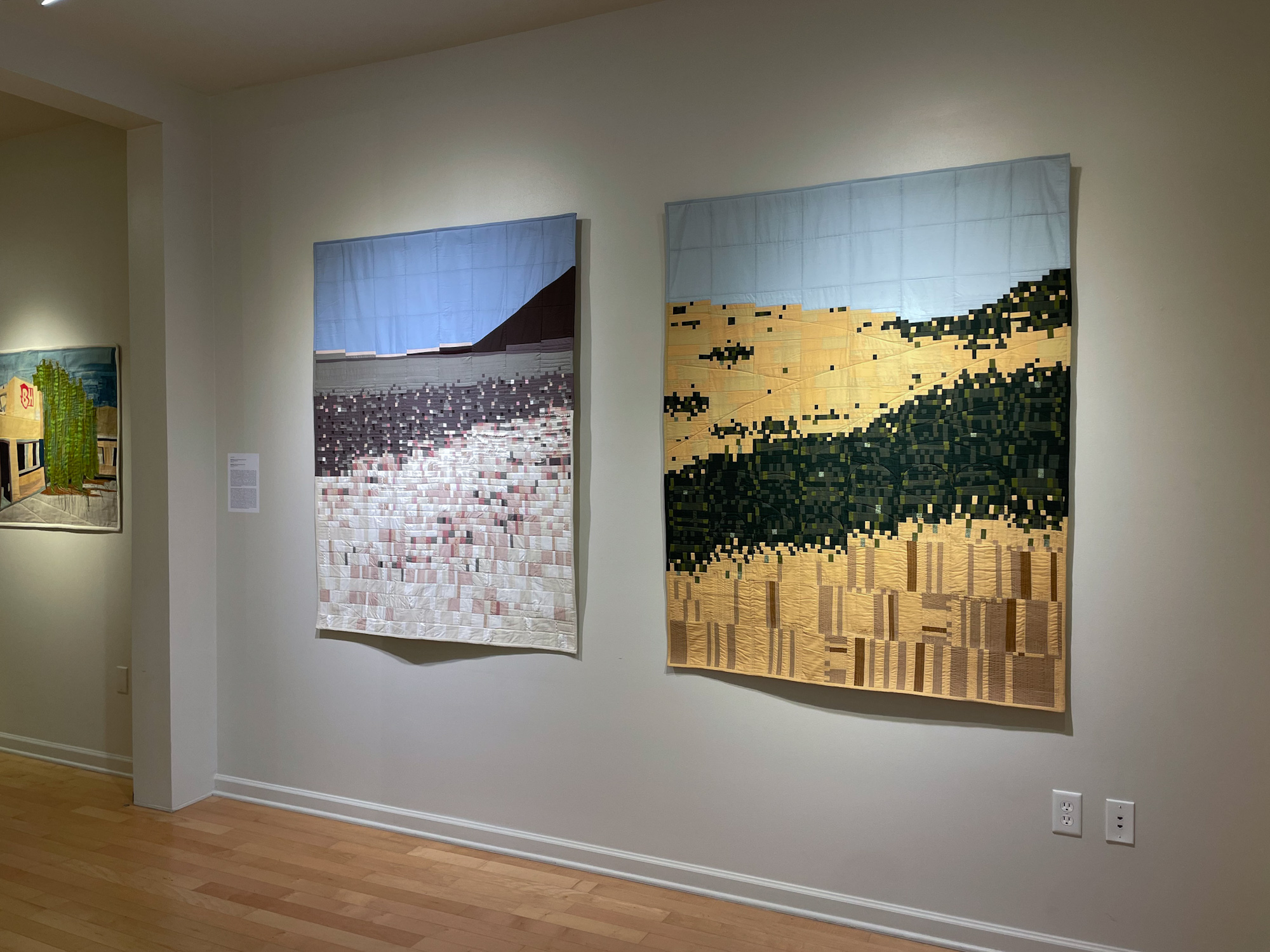
California Oak Woodland, 2023. The rolling oak dusty hill landscape is among my favorites and indicative of much of California, regardless of a specific geographic region. You might see this view in San Diego, near the Central Coast, approaching the Sierra Nevada on the way to Yosemite, or in Marin County. The canopies of these trees, their wide-reaching limbs, the ridged bark, and the circumference of the tree trunks activate my poetic sensibilities. As an artist, I am enchanted by their age and the humans, long gone, who will have gazed upon the same tree(s) for centuries. Their longevity, and sheer tree-ness, is profound to me. I had in mind the image I wanted to photograph for this piece to use as my reference, and despite the ubiquitous nature of this very familiar landscape, found it surprisingly hard to find just the right view; I finally shot the photo I was looking for on a two-lane road near Paso Robles, on the way back from the coast by Cambria. The California Oak Woodland quilt has intentional layers of subtle dusty green and tan shades in the composition that a viewer might visually lean into, and it was my intention to have the landscape feel like it was undulating or rolling as it were, as the treescape moves further away and upwards into the background.
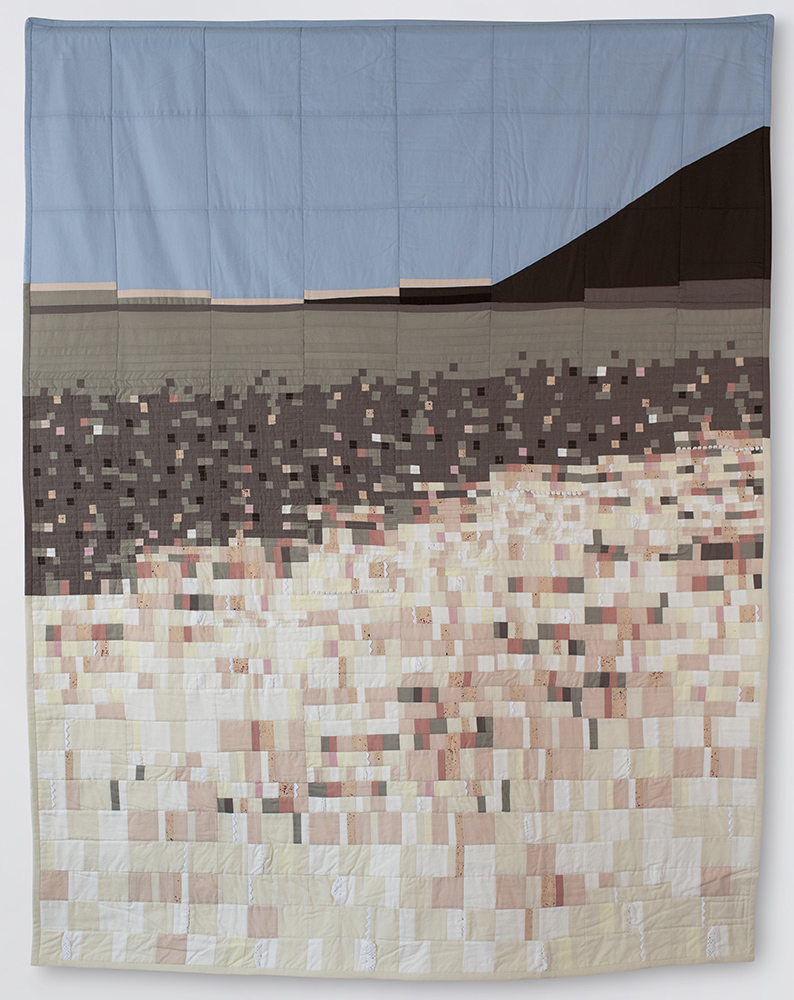
Death Valley Badwater Basin, 2023. Death Valley National Park, in Inyo County California, is a sparse, dry landscape with subtle, mostly neutral colors. Badwater Basin, one of the iconic areas of the park, sits at an elevation of 282 below sea level, is no exception. On a late spring visit several years ago, I was fascinated with the crunchy salt texture of the white alkaline crystals in the dry, arid lake bed, and took numerous photographs early in the morning before the heat set in. Later, when I started to think about how I might work an image into a quilted piece, it felt natural to incorporate pieces of chunky white crocheted lace into the seams at random intervals, creating a subtle, but intentional, three-dimensional surface, reminiscent of the salt. Death Valley feels otherworldly, but there is also an elegance in the delicate color palette of the terrain. Visually, I am drawn to the subdued shades of this landscape, while navigating my own hyper awareness of the dangers of the desert, especially one this vast, remote and lonely.

Mulholland Drive Quilt, 2021. I spent most of my childhood growing up on a suburban residential street just off of Mulholland Drive. This historic and iconic road twists and turns high above the San Fernando Valley to the north and Los Angeles to the south, splitting the two distinct city regions like a spine. The view at night was my favorite, and I used to love trying to identify specific buildings in the distance, recognizing that while the structures were still there, they also weren’t. Night time views of interior spaces, where people have perhaps unintentionally left their curtains open, neon lights in the distance, horizons, dusk, light changing from day to night, these are all visuals that continue to mesmerize and inspire me. I’m fascinated with how our perception of architectural space differs with light, real and/or artificial, influencing what we can see, that which we cannot see, what is amplified by imagination, what has been hidden, and what has been edited from our gaze. The Mulholland Drive quilt is about nighttime and the magic of the hour.


